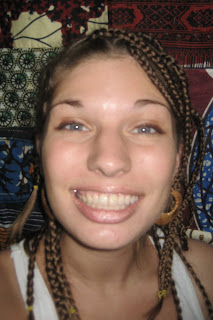
Hello Friends,
I am happy to tell you that my fundraising goal has been exceeded! It looks like I'll be staying in Liberia through November. I feel ultra blessed.
I so appreciate your prayers as I continue to find my place in all of this...whether it is a "for now" thing or something more long term...
"So I say to you, ask, and it will be given to you; seek, and you will find; knock, and it will be opened to you." [Luke 11:9]
Much Love,
Lindsay
9.11.2007


9.10.2007
#7. The one where I ask for help.
 Hello again, from Liberia :)
 Today is one week until my flight out of Africa departs.
Friday afternoon my boss approached me to ask if I'd consider staying longer. A nurse just left early because of a family emergency, leaving the ward one nurse short through November.
I am feeling more comfortable and therefore more effective here with each passing day. I love Liberia. (Most days.) There is so much joy in giving back. I finally know all the girls at the orphanage by name, even when they change their braids. Rainy season is fiiiiinally coming to an end and the sun is shining bright. I am learning about so many things here. Poverty. Music. Ethical Dilemnas. People. Global Medicine. Culture. Serving. Liberian English. Faith. Community. Resourcefulness. Why wouldn't I stay longer?
Oh wait. I miss home. I can almost taste a home cooked meal just thinking about it. I was pretty stoked about the thought of heading to the jersey shore with my girlfriends only two weekends from now. My sister has a book signing at the end of the month. [Sidebar: Danielle was published! http://www.powells.com/biblio?isbn=9780738550497] And I could really use a trip to the clearance rack at Urban Outfitters. But these are things I can look past a while longer. The clincher is the thing that unfortunately dictates way too many of our decisions all the time. Money. Mine is running out. And it's not exactly free to be here. Plus, there are bills at home.
[I hate this part.] I am wondering if anyone would be interested in financially supporting my work here, or knows of any other possible resources I could look into. Please know that I will not think you love me any less if you are not interested in giving or if you are not in a place to give. I know making ends meet is not always easy. Life is expensive. But I looked at the numbers and determined that extending my commitment in Liberia will only be possible with some assistance. [Did I mention that I hate this part?] As much as I feel really awkward about asking, something tells me I might be doing you an injustice if I didn't give you an opportunity to be a part of this mission.
Here is a breakdown of my expenses for an extra two months:
Crew Fees (room & board) $1050
Health Insurance $150 ish
Flight Changing Fee $100 ish
Random Spending Money (Transportation, Food, Toiletries, etc.) $200 ish
So the grand total is about $1500. And that's a lot of money. I am putting the need out there and trusting that if I am meant to stay it will somehow be provided for. And if it is not, coming home as planned is fine, too.
Contributions can be made at https://secure.mercyships.org/webinfo/US/staffgiving?staff_data=2266~Lindsay~Marie~Burrows
I am sorry to tell you that the IRS does not consider donations tax deductible for crew who are here less than two years. Also, donations don't become available to me until a couple weeks after they are made. So, if you are making a donation, could you just drop me an email and let me know so that I can plan accordingly? I must decide by Wednesday whether or not I can stay, and this decision will be based on funding.
 In other news...
We took the older girls from the orphanage to the beach on Saturday for a picnic and a swim. They had NEVER been to the beach before. An amazing time was had by all. I am trying to attach a picture so that you can appreciate their adorable-ness with me. Our tuesday afternoons with them are going so well. Two weeks ago I talked to them about purity. They were receptive, and it went better than I expected.
Things are going pretty well in the hospital. Most of our patients who are now in the ward are recovering from eye surgeries, plastic surgeries on old burn injuries and maxillofacial surgeries for facial deformities and tumors. People who look different here for any reason are often outcasted from society. So we are not only healing their deformities but also giving them a chance to be accepted again.
The majority of our VVF ladies have been discharged from the ward. Before they leave we have a "dress ceremony" where they are given a new dress and we celebrate the healing of their bodies together in song. They thank God for what He has done for them. They thank us for being a part of it. It has been so amazing to rejoice with them! We only have six ladies here still recovering from their VVF surgeries. Can I ask you to pray for them? Gorpue is sixty years old, and her surgery did not go so well. She ended up with a colostomy and an awful wound. She has an infection. Not only is she is still leaking, but her prognosis does not look hopeful. I am sad that she came to the Mercy Ship expecting healing and ended up worse off than when she arrived. Unfortunately this is always a risk with surgery. Also, Baby is a patient who came in for her second VVF surgery. Her body is very damaged, and when the first surgery failed in June she was sent back to us. The woman who she was supposed to be staying with kicked her out. "Baby can only live here if her problem is fixed," she said. Unfortunately, she still has some leakage after her second surgery. Baby is 22 years old and has so much life inside of her. There is not much more we can do for her. She is healthy aside from her leaking. All of these ladies' desire is to return to their families. We pray that this will be an option for them. And if it is not, that God will make another way for them and provide them with the grace to cope along the way.
Yesterday we had a church service in the ward. The African workers lead us in worship, to the beat of the African drum, "I am an overcomer. I will never give up." I remain in awe of the hope in these broken people.
Much Love,
Lindsay
8.17.2007
Africa....#6?
Hello again from Liberia,
I hope you are enjoying the august sunshine wherever you are today. So it's been awhile. But I'm hoping to make up for it now. You might want to get cozy if you have a few minutes to spare. It's a long one. Here goes...
In the Hospital.
The hospital is bustling with recovering post-op patients. We are on our third round of VVF patients, and are also still doing orthopedics as well. In the next few weeks our maxillofacial surgeon will arrive, and we will be fixing cleft lip and palates and removing facial tumors from a horrible condition called Noma, which is caused by malnutrition. But for now, clubbed feet are being turned forward, lingering bullets are being removed, unhealed fractures are being repaired, and chronic leaking is being stopped. I spend most of my days at work caring for the VVF ladies, but occasionally am assigned to the orthopedic unit, which is filled primarily with children. This means that I get to hold adorable babies with casts on their legs - for my job! I can't complain.
Two of our VVF patients surprised us when they arrived a few weeks ago, ready to be admitted for surgery, with their babies on their backs. Baby James and Baby Junior were born just a few days apart in January of this year, but looking at them you would never know it. Baby James was a solid, healthy African boy, while baby Junior looked underfed and much younger than his age of seven months. He lacked the ability to hold up his head, and his eyes wandered in different directions. Both of the boys' prolonged deliveries were the cause of their mother's incontinence. Baby Junior's mom, twenty one year old Amelia, was very sick for the month after his birth, making her unable to breastfeed. Her body never caught up in milk production, so she was forced to supplement. But formula was out of the budget. Baby Junior was raised on a powdered product similar to coffee creamer with very little nutritional value.
I first cared for these two beautiful babies last Friday night. Baby James' mom cuddled him in her bed through the night and nursed him when he cried. Baby Junior's mom turned her back to him through the night and pretended not to hear when he cried. He laid in his dirty diapers until someone else intervened. A crying baby is not exactly ideal in a ward filled with twenty women recovering from surgery who are trying to sleep.
We brainstormed at the nurses' station. Why wouldn't Amelia care for her baby? Baby Junior is the reason Amelia leaks, the reason she was shunned from her society, the reason she nearly died. Is it possible that she resented him? Also, African mothers tend to keep more distance between themselves and their babies than western women do. They must protect their hearts. Infant mortality rates are horrendous in underdeveloped countries. Baby Junior was not well. And as a mother of three, Amelia knew it.
So we, the nursing staff, were forced to intervene. We asked Amelia to feed her baby. She would nod her head in agreement as she accepted the warm bottle, then put it down and go back to sleep the moment we walked away. She sighed and moaned and looked inconvenienced when we would hand her a diaper upon noticing that the junior's was soaked. "You take him," she would say. Finally, we told Amelia she must feed her baby. She was far enough out of surgery to look after for his needs. And we weren't going to be there to take care of Junior when they went home. The charge nurse created a feeding schedule. We picked up the crying baby and placed him in his mother's arms again and again until it became natural. We talked to Amelia about the importance of loving her baby in order for him to grow healthy. Eventually, something clicked.
Today has been a week since the first frustrating shift that I listened to baby Junior cry throughout the night. His formerly frail limbs are getting meaty, and he grown has a double chin! His eyes seem to focus perfectly now. And he is gradually holding up his own neck a little more each day. Apparently these abnormalities were symptoms of malnutrition.
Amelia smiles now, with good reason. She is no longer leaking and her son is becoming healthy. She asks for diapers when Junior's is dirty. She feeds him when it's time. She looks him in the eye. She kisses him. She holds her baby with no prompting at all.
I am awed at the difference one week made. I thank God that Junior has a mother who loves him and a body that is growing strong.
We pity our patients when we hear that many have three and four children before reaching the age of twenty. The irony? They pity us when they hear that we are in our twenties and don't have any babies! A couple of the ladies have told us they will pray that we can start having babies soon. I hope not too soon! It seems that bearing many children here is a sign of success for a woman, of pride for a man, and a promise of prosperity for the future of both parents, because with no social security checks coming to the elderly their descendants become their only source of income.

[This is baby James. You can see by the size of him that he is the one who was clearly well fed from the start. And, yes, I did intervene before he strangled himself with my stethoscope.]
I hope you are enjoying the august sunshine wherever you are today. So it's been awhile. But I'm hoping to make up for it now. You might want to get cozy if you have a few minutes to spare. It's a long one. Here goes...
In the Hospital.
The hospital is bustling with recovering post-op patients. We are on our third round of VVF patients, and are also still doing orthopedics as well. In the next few weeks our maxillofacial surgeon will arrive, and we will be fixing cleft lip and palates and removing facial tumors from a horrible condition called Noma, which is caused by malnutrition. But for now, clubbed feet are being turned forward, lingering bullets are being removed, unhealed fractures are being repaired, and chronic leaking is being stopped. I spend most of my days at work caring for the VVF ladies, but occasionally am assigned to the orthopedic unit, which is filled primarily with children. This means that I get to hold adorable babies with casts on their legs - for my job! I can't complain.
Two of our VVF patients surprised us when they arrived a few weeks ago, ready to be admitted for surgery, with their babies on their backs. Baby James and Baby Junior were born just a few days apart in January of this year, but looking at them you would never know it. Baby James was a solid, healthy African boy, while baby Junior looked underfed and much younger than his age of seven months. He lacked the ability to hold up his head, and his eyes wandered in different directions. Both of the boys' prolonged deliveries were the cause of their mother's incontinence. Baby Junior's mom, twenty one year old Amelia, was very sick for the month after his birth, making her unable to breastfeed. Her body never caught up in milk production, so she was forced to supplement. But formula was out of the budget. Baby Junior was raised on a powdered product similar to coffee creamer with very little nutritional value.
I first cared for these two beautiful babies last Friday night. Baby James' mom cuddled him in her bed through the night and nursed him when he cried. Baby Junior's mom turned her back to him through the night and pretended not to hear when he cried. He laid in his dirty diapers until someone else intervened. A crying baby is not exactly ideal in a ward filled with twenty women recovering from surgery who are trying to sleep.
We brainstormed at the nurses' station. Why wouldn't Amelia care for her baby? Baby Junior is the reason Amelia leaks, the reason she was shunned from her society, the reason she nearly died. Is it possible that she resented him? Also, African mothers tend to keep more distance between themselves and their babies than western women do. They must protect their hearts. Infant mortality rates are horrendous in underdeveloped countries. Baby Junior was not well. And as a mother of three, Amelia knew it.
So we, the nursing staff, were forced to intervene. We asked Amelia to feed her baby. She would nod her head in agreement as she accepted the warm bottle, then put it down and go back to sleep the moment we walked away. She sighed and moaned and looked inconvenienced when we would hand her a diaper upon noticing that the junior's was soaked. "You take him," she would say. Finally, we told Amelia she must feed her baby. She was far enough out of surgery to look after for his needs. And we weren't going to be there to take care of Junior when they went home. The charge nurse created a feeding schedule. We picked up the crying baby and placed him in his mother's arms again and again until it became natural. We talked to Amelia about the importance of loving her baby in order for him to grow healthy. Eventually, something clicked.
Today has been a week since the first frustrating shift that I listened to baby Junior cry throughout the night. His formerly frail limbs are getting meaty, and he grown has a double chin! His eyes seem to focus perfectly now. And he is gradually holding up his own neck a little more each day. Apparently these abnormalities were symptoms of malnutrition.
Amelia smiles now, with good reason. She is no longer leaking and her son is becoming healthy. She asks for diapers when Junior's is dirty. She feeds him when it's time. She looks him in the eye. She kisses him. She holds her baby with no prompting at all.
I am awed at the difference one week made. I thank God that Junior has a mother who loves him and a body that is growing strong.
We pity our patients when we hear that many have three and four children before reaching the age of twenty. The irony? They pity us when they hear that we are in our twenties and don't have any babies! A couple of the ladies have told us they will pray that we can start having babies soon. I hope not too soon! It seems that bearing many children here is a sign of success for a woman, of pride for a man, and a promise of prosperity for the future of both parents, because with no social security checks coming to the elderly their descendants become their only source of income.

[This is baby James. You can see by the size of him that he is the one who was clearly well fed from the start. And, yes, I did intervene before he strangled himself with my stethoscope.]

[Adorable orthopedic patients]

[Bird's eye view of the pediatric ward]
Monrovia, Liberia.
This city is like nothing I have experienced before. I will share with you some of my the crazy details about going into town.
Hailing a cab means racing ahead of the herd of people around you to whichever cab pulls up, then piling in like sardines with complete strangers. The cabs are small cars – usually four door Nissan Sentra's or Toyota Corolla's, and they are older. There is no guarantee of handles on the doors or fabric on the seats, much less an intact exterior. By law, a cab can hold up to seven people. Seven people! That means two in the passenger seat and four in the back. Personal space is an irrelevant concept.
Going for a ride anywhere around here is pretty much synonymous for going off-roading. I remember feeling nervous in the beginning, but it's become just another part of the adventure. The dirt roads are plagued with enormous potholes which grow into ditches and overflow with mud this time of year. Mercy Ships has SUV's that we take into town, but the cabs are only cars. I have been pleasantly surprised that we've made it out of many massive puddles when in my head I was thinking that there was just no way. Only one time on the way to the beach did we get stuck in one. In less than a minute a few local men had run over to push and we were out of the water in no time.
Going out to eat means taking a risk of course, and waiting and waiting and waiting for your food. Time is a relative concept here, like in most warm climated cultures. At one restaurant the waiter said that our food would be five minutes and it actually took another hour! And I've heard much worse horror stories. There are a few restaurants that serve food for internationals rather than the typical Liberian cuisine. Some are on the beach, with palm trees! Again, I really can't complain. It is refreshing to get off the ship and of course to eat food that is a little bit closer to normal.
Going to the market means making your way through massive crowds until you find the item you are after, running from the vendors that harass you to buy their products if you should even glance at them too long, bartering like your life depends on it if you hope to get a reasonable price in spite of the fact that you are white, and doing your best to ignore the overly zealous local men all the while. It doesn't matter what your age or how long it's been since you've showered, if you are a white woman, you will be proposed to in the market. The way men approach women is a little different here. Last week I heard my favorite quote so far, "I am talking to you white woman. You speak to me now." Something tells me this kind of behavior wouldn't go over so well back home!
Sounds crazy here, I know. But it's amazing at the same time. I wouldn't trade my time in this place for the whole world if I could.
 [A market downtown]
Life onboard the Africa Mercy.
Neighbors are co-workers. Co-workers are friends. Friends become family as we eat, sleep, and live under one roof (deck?). I am thankful to be a part of this community.
People come from all corners of the world to be here. English is not everyone's first language, but is the official language of the ship. This means I get to hear phrases like "I am plenty running in a hurry" and "that is rubbish!" on a regular basis. The Africans like to add the letter "o" to the end of any word, so terms like "sorry-o", "hi-o," and "thank you-o," are common as well. This boat is an incredible collision of languages, of cultures, of values, of passions. It is both entertaining and educational.
 [Dutchies. Minus that one on the right.]
Everything we need is here on our air conditioned vessel: a laundromat, a dining hall, a library, a post office, a bank, a hospital, a hair salon, a convenient store with the bare ssentials, a modified Starbucks café, and a second hand "boutique" where one crewmember's trash becomes another crewmember's treasure. We are limited to one load of laundry a week and two minutes in the shower each day. The plumbing system works on good days. The internet connection is turtle speed. We watch movies gathered around the largest screened laptop computer we can find.
This might not sound too luxurious in comparison to American standards, but in comparison to what lies beyond the gates of our port we are actually living in a palace. So much so that I think our lofty accommodations create a barrier between us and the African people, as if there weren't enough differences already. They see us as being filthy rich. And in comparison, we are. It hinders relationships between us and the community.
There are days when I long to live outside the comforts of this boat. I want to sleep in a grass hut and carry buckets of water on my head. I want to connect with the Liberian people. But how much does a white girl from the South Jersey 'burbs reallly have to offer in such a place? Maybe one day...Who knows.
Collin Carroll.
I appreciate the many apologies I received about Collin's death. I should've clarified in my last email that although I was sad, I was holding up okay. There are over three hundred people living on board, and Collin was really an acquaintance to me. A few days before he passed away Collin overheard me say that I had never tried a mango before at lunch. Next thing I knew, a piece of his was lying on my plate. We were friendly but I don't remember ever having a full conversation with him.
There was a memorial service held for Collin on board two weeks ago. His co-worker shared about his dedication to the dental team here, and how Collin would arrive to work early to ensure the team was equipped to treat as many patients as possible. His friend Hilary spoke about how Collin shared with her his passion for spending Saturday mornings at a local orphanage. This was something she never thought she would do, but found herself hooked after going with Collin just one time. Collin's supervisor shared about how Collin had completed a five year pre-med degree in just three and a half years, not wasting any time or money. Because of his dedication to his studies, his father offered to send him anywhere in the world. Collin chose Africa.
I pray for God's grace for Collin's parents and two sisters, to uphold them through this tragic loss. I would be grateful if you would try to lift them up in your prayers as well.
Billy Joel had a valid point when he declared that "only the good die young." I wonder if people whose lives will end early somehow intrinsically know this fact deep inside of them. They usually seem to be the ones that live the hardest and love the most in their time here. I am sad to see another beautiful soul leave the earth so early. But there is peace to be found in knowing that Collin will live forever in Heaven. Not because he was in Liberia to serve, and not because he did more good deeds than bad over the span of his short life. The Bible tells us that no one of us could ever do enough good things to earn our way to heaven, because we are all sinful by nature. Jesus' sacrifice on the cross is the only payment worthy enough to get us there. Collin professed to believe that, and did his best to live accordingly. And that is why we can rest assured that he is in a better place now.
The Orphanage.
I would estimate that there are between thirty and forty kids at God's home orphanage down the road. The beauty in their faces outweighs the sight of their worn clothes and skinny bodies a million times. Their home leaves much to be desired. We do what we can to shed some light into their world for a couple of hours on Saturday mornings. We sing songs with them: fun songs, and songs about God. Someone tells a story from the Bible. We play games, color and read books. They like to touch our hair, which is a little different from theirs, and "plaid" (braid) it. We hug them, and hold the little ones. There are three toddlers who all jump into our laps the minute we arrive, and never fail to fall asleep there, regardless of how long its been since they slept last. They don't wear diapers, and often leave little puddles behind!
We have a club for the older girls on Tuesday afternoons. There are about ten of them: Maima, Jenne, Martha, Korlu, Marie, Bendu, Naomi and Patricia are the names I can remember. The captain's wife, Rachel, is our leader. Her goal is to reach the older kids in the orphanage, because whether or not they realize it, they are the role models that set the standards for all the kids. Rachel is a former teacher with a wealth of knowledge on relating to these kids. She comes up with activities that not only entertain them for a while, but also teach them how to take initiative and be productive using the little resources they have. Rachel, in all of her smoothness, somehow convinced the tailor down the road to save his scraps of fabric to give to the girls for free. She taught the girls to cut the fabric into very thin strands which they use to crochet into purses. The idea was brilliant and the bags are coming along so nicely. "Fine," is what the Africans would call them. They look at us like we're speaking Greek when we use the words "pretty," or "cute." Everything is "fine." If the bags look fine enough when they are complete, we are going to sell them on the ship to help the girls earn some money.
The orphanage is dark and dreary, especially in the girls' room. The walls are lined with triple decker bunk beds with bare mattresses - no pillows, no linens. There are small windows only at the tops of the walls, which allow enough sunlight in to keep the room dimly lit. The closet was filled with one large mound of clothes, which each girl rummages through to choose clothes from daily. There is no sense of personal ownership – everything belongs to everybody. On one hand it is captivating to see the sense of community cultivated amongst the girls. But on the other hand, experiencing ownership and individuality could be empowering for them.
Last week we gave the girls money to go to the market to buy hangers and told them we'd all clean out the closet together this week. When we arrived Tuesday we found the girls gathered around a closet which was already cleaned out with clothes hanging up. They had also hung the mosquito nets that Rachel had gotten them over each of their bunks. Although these are intended to be merely functional nets, they created a canopy effect over the beds, and they look pretty. We were proud of them for taking the initiative on their own and glad that they are learning to value the possessions that they do have.
At Church.
I hesitate to write this paragraph because it's another not so happy one. But I know it's only fair share the negative as well as the positive parts of my experience with you. Some people from the ship have been donating large amounts of money to Jamaica Road Church to be put towards basic upgrades on the building. We have money; they need money. Why not share it? In theory, this seems only logical. However, most mission organizations ban their volunteers from donating money to local organizations because of the issues that usually arise. Mercy Ships does not. Apparently it's acceptable in African culture to ask for something if you have a need, and know someone who could fill that need. Now they are posting new large financial burdens in the bulletin. The last Sunday that I attended church, I was asked for money twice. I told them I am a volunteer and I am here to give back to their country by working. It was awkward. This made me feel kind of crappy about something that had previously seemed so beautiful. I questioned their motives for welcoming us so warmly in the first place. My mom assured me that I can not write off their kindness as a whole, and that I must remember that there no perfect church exists simply because perfect people do not exist. She's usually right. I hope this time is no exception. I pray that we are able to really connect with the people at Jamaica Road Church in spite of our diverse backgrounds and financial situations, and that God will give us discretion about how and when and how much to give.
About Me.
Things are going really well for me. After two months I am feeling settled on the ship and getting more comfortable in the community as well. One month to go. I hope to make the most out of it.
It was easy to make the decision to come to Africa. What is harder for me? Abiding in love. Making a choice to do live selflessly on a day by day, minute by minute basis. Putting the needs of others before my own, and doing it gladly. It is not where we are at or what we are doing that is most significant, but how much love we do it with.
I had hoped being in Africa would change me into a selfless being. Au contraire, my friends. I remain far from perfect, just like always. In spite of the massive needs around me, my own miniscule needs continue to rank first in my head all day long. There are times when I am caring for my patients while the true first thought on my mind is when I will have a chance to take a coffee break. I still become irritated by my own conditions of hunger and fatigue while I live alongside a community of people who do not have meals to eat or beds to sleep in. I still desire to have new things while I am surrounded by people who have never owned a fraction of my possessions. I guess these are consequences of our human condition.
So I do my best to seek God each day, to turn my selfish desires over to Him, to ask Him to fill me with His desires for each situation that I encounter. It is only because of God's love inside of me that I am motivated me to do any good thing.
"And we have known and believed the love that God has for us. God is love, and he who abides in love abides in God, and God in him." [I John 4:16, The Bible]
I'd like to thank you again for your continued love, prayers, and encouraging words while I am far from home. They mean so much.
Much Love,
Lindsay
8.01.2007
Sad News. From Africa.
Hello,
It's been a sad week here. Because you guys have been walking this journey with me every step of the way, it is only fair to keep you informed. One of our crew members, Collin Carroll, lost his life on Sunday in a terrible drowning accident at a local beach. The currents here can be really rough, and there are no life guards. We know Collin is in a better place, but still cannot imagine the heartache his family is enduring. The community within the ship has come together beautifully to support those who were closest to him and pray for those suffering at home. Three of his closest friends here, who were with him on Sunday, are flying out today to join with his family and friends for services in his hometown in Texas. We are sending with them a book of our apologies to his family. Today would have been Collin's twenty second birthday.
Enclosed is an article from the newspaper in Collin's hometown.
Much Love,
Lindsay
Article published Jul 31, 2007
Rusk Man Dies On Mercy Ships Trip
By PATRICK BUTLER
Religion Editor
A volunteer from East Texas with Mercy Ships of Garden Valley died in Monrovia, Liberia, after he was pulled under water by severe ocean currents.
Collin Carroll, 21, of Rusk, had been swimming with friends Saturday and "apparently drowned" after rescue efforts to revive him failed, Mercy Ships officials said on Monday.
Carroll had been with Mercy Ships since June 8 and was working as a dental program coordinator aboard the Africa Mercy, a 500-foot, nine-deck hospital ship currently docked in
Monrovia.
Carroll was a 2006 Texas A&M graduate with a degree in biomedical sciences. He would have been 22 on Wednesday.
"Our entire organization is in mourning following this tragedy," said Sam Smith, a vice president with Mercy Ships. "We notified Collin's family on Sunday and offered any help we could and all the services at our disposal."
Carroll had been out having a day of fun, Smith said.
"Collin was on his day off," he said. "Our information is that he had gone to a popular beach outside of Monrovia with three other crew members. After lunch, they all ran into the water and the two men (Carroll and his roommate) went in further than the women."
The men soon encountered strong currents, Smith said.
"They were attempting to swim sideways out of 'riptide' as you do when caught in ocean currents," he said, "when a big wave came and dragged Collin underwater. He didn't come up."
Finally finding him in shallow water, the Mercy Ship crew members swimming with Carroll administered CPR, Smith said.
"It was sadly unsuccessful," he said.
COMMITTED
Carroll was a "committed, caring and concerned" Christian, active in his church and looking forward to his medical mission at Mercy Ships, said Carroll's pastor, the Rev. Lee Welch of First Baptist Church of Rusk.
"He was interested in the medical side of things," Welch said. "He even got a driver license in Liberia so he could pick up patients and get them to the ship for medical attention."
Carroll's parents, Jeff and Sandy Carroll, had offered to send Collin "anywhere in the world after graduating from Texas A&M," Smith said. "He chose Liberia."
On his 2007 application to Mercy Ships, Carroll wrote, "I have two options. I can start a meaningless job that I would soon have to leave to continue my education, or I can do something that will have a profound and meaningful effect on my life while glorifying God and helping those in need. I choose the latter."
The health care manager aboard the Africa Mercy, Jean Campbell, said, "Collin was a real strong person on our dental team helping coordinate operations and others who worked with him. He was a great encourager, a hard worker and a tremendous asset to our team. He will really be missed."
Solfrid Quist, executive director of the Africa Mercy, said, "Collin was always thinking about other people and put others first. He was caring and very concerned about others."
Welch said he was notified of the tragedy just before the 11 a.m. service at First Baptist on Sunday.
"Don Stephens, (founder of Mercy Ships) came down personally on Sunday to speak with Jeff and Sandy and give them the news," Welch said. "It was heartbreaking."
In a prepared statement to the Tyler Morning Telegraph, Stephens said, "Collin wrote the following words in his Mercy Ships application, 'Jesus is truly my outlook on each day. Jesus is my source of strength, my inspiration, and my ever-present friend. Without Him, I would be nothing."
"Collin chose Mercy Ships because we combine the doing of the good news with speaking the good news among the worlds poorest. Collin was feeding the hungry, caring for the stranger and visiting the sick - precisely the actions commended by our Lord in Matthew chapter 25. Jesus said those who do what Collin did would inherit the kingdom prepared from the foundation of the world."
It was an honor to serve with Collin Carroll, Stephens said.
"I speak for the entire Mercy Ships family when I say we were honored to have such a fine young man as a member of our Mercy Ships Crew. I pray his example in life would help to encourage all who knew him, to follow his lead."
Welch said, "Collin's parents just got the news no parent ever wants to hear. I don't know why this happened. I don't have any answers. I don't try to give explanations, because I don't have any. Our hearts are grieving for them and we're here for them."
It's been a sad week here. Because you guys have been walking this journey with me every step of the way, it is only fair to keep you informed. One of our crew members, Collin Carroll, lost his life on Sunday in a terrible drowning accident at a local beach. The currents here can be really rough, and there are no life guards. We know Collin is in a better place, but still cannot imagine the heartache his family is enduring. The community within the ship has come together beautifully to support those who were closest to him and pray for those suffering at home. Three of his closest friends here, who were with him on Sunday, are flying out today to join with his family and friends for services in his hometown in Texas. We are sending with them a book of our apologies to his family. Today would have been Collin's twenty second birthday.
Enclosed is an article from the newspaper in Collin's hometown.
Much Love,
Lindsay
Article published Jul 31, 2007
Rusk Man Dies On Mercy Ships Trip
By PATRICK BUTLER
Religion Editor
A volunteer from East Texas with Mercy Ships of Garden Valley died in Monrovia, Liberia, after he was pulled under water by severe ocean currents.
Collin Carroll, 21, of Rusk, had been swimming with friends Saturday and "apparently drowned" after rescue efforts to revive him failed, Mercy Ships officials said on Monday.
Carroll had been with Mercy Ships since June 8 and was working as a dental program coordinator aboard the Africa Mercy, a 500-foot, nine-deck hospital ship currently docked in
Monrovia.
Carroll was a 2006 Texas A&M graduate with a degree in biomedical sciences. He would have been 22 on Wednesday.
"Our entire organization is in mourning following this tragedy," said Sam Smith, a vice president with Mercy Ships. "We notified Collin's family on Sunday and offered any help we could and all the services at our disposal."
Carroll had been out having a day of fun, Smith said.
"Collin was on his day off," he said. "Our information is that he had gone to a popular beach outside of Monrovia with three other crew members. After lunch, they all ran into the water and the two men (Carroll and his roommate) went in further than the women."
The men soon encountered strong currents, Smith said.
"They were attempting to swim sideways out of 'riptide' as you do when caught in ocean currents," he said, "when a big wave came and dragged Collin underwater. He didn't come up."
Finally finding him in shallow water, the Mercy Ship crew members swimming with Carroll administered CPR, Smith said.
"It was sadly unsuccessful," he said.
COMMITTED
Carroll was a "committed, caring and concerned" Christian, active in his church and looking forward to his medical mission at Mercy Ships, said Carroll's pastor, the Rev. Lee Welch of First Baptist Church of Rusk.
"He was interested in the medical side of things," Welch said. "He even got a driver license in Liberia so he could pick up patients and get them to the ship for medical attention."
Carroll's parents, Jeff and Sandy Carroll, had offered to send Collin "anywhere in the world after graduating from Texas A&M," Smith said. "He chose Liberia."
On his 2007 application to Mercy Ships, Carroll wrote, "I have two options. I can start a meaningless job that I would soon have to leave to continue my education, or I can do something that will have a profound and meaningful effect on my life while glorifying God and helping those in need. I choose the latter."
The health care manager aboard the Africa Mercy, Jean Campbell, said, "Collin was a real strong person on our dental team helping coordinate operations and others who worked with him. He was a great encourager, a hard worker and a tremendous asset to our team. He will really be missed."
Solfrid Quist, executive director of the Africa Mercy, said, "Collin was always thinking about other people and put others first. He was caring and very concerned about others."
Welch said he was notified of the tragedy just before the 11 a.m. service at First Baptist on Sunday.
"Don Stephens, (founder of Mercy Ships) came down personally on Sunday to speak with Jeff and Sandy and give them the news," Welch said. "It was heartbreaking."
In a prepared statement to the Tyler Morning Telegraph, Stephens said, "Collin wrote the following words in his Mercy Ships application, 'Jesus is truly my outlook on each day. Jesus is my source of strength, my inspiration, and my ever-present friend. Without Him, I would be nothing."
"Collin chose Mercy Ships because we combine the doing of the good news with speaking the good news among the worlds poorest. Collin was feeding the hungry, caring for the stranger and visiting the sick - precisely the actions commended by our Lord in Matthew chapter 25. Jesus said those who do what Collin did would inherit the kingdom prepared from the foundation of the world."
It was an honor to serve with Collin Carroll, Stephens said.
"I speak for the entire Mercy Ships family when I say we were honored to have such a fine young man as a member of our Mercy Ships Crew. I pray his example in life would help to encourage all who knew him, to follow his lead."
Welch said, "Collin's parents just got the news no parent ever wants to hear. I don't know why this happened. I don't have any answers. I don't try to give explanations, because I don't have any. Our hearts are grieving for them and we're here for them."
7.24.2007
Africa. Take Four.

Hello again from Liberia :)
Walking to church on Sunday, my feet and ankles became completely covered in mud which was impossible to avoid in the swampy road which, in parts, has become one large puddle. One of the women at church, an usher, asked to take me out back to clean my feet. She refused to take "no" for an answer and she scrubbed my grubby feet until they were clean.
I came here to serve, yet I am being served.
Church started and the choir announced a special selection - an acapello song about called "Mama Liberia." I hope to somehow get a recording of this incredible song to bring home, because I have not heard anything like it before. Their voices were strong beautiful, and my eyes welled up as they sang so optimistically about their broken country, which they continued to thank God for.
I came here to bless, yet I am being blessed.
Isn't it ironic how the times when we are most willing to give are often the times when we actually receive the most? It does not take traveling across the world to learn this principle, as I'm sure most of you have experienced it on many levels in your own lives.
"He who finds his life will lose it, and He who loses his life for My sake will find it." --- Jesus [Matthew 10:39]
Enclosed are the first two ship reports for this Liberian outreach, incase you desire to know the details of what is being accomplished here. You will notice talk of eye surgeries, which I did not previously mention because I have not been caring for this patient population, whose care is done on an outpatient basis. The eye department, however, is doing amazing things for many Liberians through short, minimally invasive eye surgeries. They hosted a "Celebrate Sight" day last week, in which 185 of their patients came back for a post-op visit, a meal in our cafeteria, and a celebration of the restoration of many of their sight.
Thank you again for all of your prayers. I am safe and happy and healthy, and our patients are doing quite well overall - so I guess that means they are working. Thank you, also, for your encouraging responses to my emails. They are refreshing. I apologize to those who I have not had the chance to respond to yet, and will do my best in the days ahead.
Much Love,
Lindsay
Monrovia, Liberia July 2, 2007 -- The sacrificial labor of hundreds of volunteers, and the generous gifts of thousands of contributors, came together this past week to produce an historic moment in Mercy Ships history. On Monday, June 25, the first surgery was successfully completed onboard the charity's newest floating hospital, the Africa Mercy.
Ophthalmic surgeon and Mercy Ships Vice President for International Programs, Dr. Glenn Strauss, says the ship's very first patient, a 90-year-old woman with blinding cataracts, reported being able to see again before she even left his operating table. Patient Suah Paye was so overjoyed she literally danced around the surgical suite, singing and praising God for her restored sight.
Suah lived her entire life in a small village called Oil Town in West-Central Liberia. Along with her large family, Suah is a subsistence farmer; raising their own food along with a bit left over to sell in the market.
Three years ago, cataracts stole the last of Suah's sight. The loss was devastating for such a proud, active woman. She missed being able to work on her farm and missed fishing in the nearby river. She hated not being able to dress herself or even to use the toilet without assistance.
Suah thanked the doctors and nurses for her renewed vision, saying, "When I get home I will gather my people and tell them what you have done for me. I can't pay you, but God will pay you. He will bless you and your children and your children's children."
As Suah's onboard eye surgery got underway, obstetric screening began in the dockside tents for women suffering from birth injuries. Forty-nine women attended the screening. Most were scheduled for surgery over the coming weeks.
The first birth injury repair surgeries were conducted onboard the next day. Thirty-five year old Mamie Paye of North-Central Liberia was one of the patients selected to undergo the procedure on the new ship. Mamie has leaked urine constantly since she suffered a birth injury in 1995. She was abandoned by her husband as a result of the incontinence, a tragically common occurrence.
"Everyday I cry," Mamie says. "When you have this problem you don't have friends. You don't have nobody. People gossip the whole day about you. People abandon you. But God doesn't ever abandon nobody."
Suah and Mamie represent the first of hundreds of patients to be treated onboard the Africa Mercy during the remaining months of the Liberian field service, as well as the tens of thousands to be cared for without charge in the years to come.
As additional volunteers arrive and are trained, the Health Care team will ramp up their activities. The dental team is already seeing patients. Orthopaedic surgery will commence onboard on July 9. Plastic surgery will begin for burn patients in early September with maxillofacial operations being offered later the same month. Ear, nose and throat procedures are slated for October and November.
Mercy Ships is still seeking volunteers to fill positions for the balance of the Liberia field service. Some medical and community development projects are still in need of funding. To learn more write to info@mercyships.org.
Monrovia, Liberia 16 July 2007 -- The Mercy Ships Orthopaedic Surgical Team launched a ten-week program of operations onboard the Africa Mercy this past week. Patients have already been scheduled for more than half of the 100 free surgical slots reserved for orthopaedics. The first operation was conducted on Tuesday, July 10.
After several days spent screening potential patients, volunteer Orthopaedic Surgeon Dr. Brian Sims commented, "I think the thing that impresses me most is just how hardy the African people are; what they're able to put up with and continue to work and function in life in spite of what would normally be a completely disabling injury.
"There was a woman I saw yesterday, I think she was in her seventies, and she had a non-union fracture of her femur. So basically the center of her femur moved whenever she walked. Yet she walked in to the screening and she walked out again. When we told her we were going to schedule her for surgery, she just got the biggest smile and she put her hands in the air and she was praising God," Sims recalled.
The orthopaedic team has encountered a variety of injuries and physical defects; everything from polio deformities to old grenade and gunshot wounds sustained during the 14-year Liberian Civil War. However, more than half the surgeries scheduled to date are to correct club feet. Treating patients in their teens and even older with the deformity is not something Dr. Sims sees in his stateside practice.
He says, "The true, neglected club foot; the foot that's never had any treatment whatsoever is just really unheard of [in developed countries]. It's usually diagnosed within the first day of life. Here it's common to see people who've had a club foot all their lives."
Two children with club feet underwent free corrective surgeries during the first week of operations on the Africa Mercy. Two-year-old Cynthia Cooper and nine-year-old Benedict Menkoah had their feet straightened by Dr. Sims during operations that took several hours each. Both children have endured tremendous ridicule and persecution because of their deformities. Both were abandoned by their fathers.
Orthopaedic team member Dawn Crowther reported, "We especially enjoy being able to schedule the children. We've talked to teens and adults who've had the clubfeet or some other deformity. Many times they tell us they've never been to school because of the handicap. Maybe by helping them at such a young age we'll be able to impact the course of their lives, to give them a future they wouldn't otherwise have."
The orthopaedic team is partnering with medical professionals both on and off the ship to ensure adequate care continues even after the surgical team departs. Orthopaedic Care Coordinator Annie McFarland will see each patient every two weeks through September. Physical and occupational therapists volunteering with Mercy Ships will provide rehabilitation services. A Liberian prosthetics lab has generously offered to build and maintain any prosthetics the patients might need without charge.
Eight surgeons from the U.S. and the U.K. have agreed to fly into Liberia at their own expense to conduct the surgeries in the coming weeks. Volunteer surgeons are still needed for an even longer orthopaedic program planned for the ship's next port of call. Six full months of orthopaedic surgery are being scheduled for the field service to Sierra Leone in 2008.
For more information on this and other programs offered by Mercy Ships, write info@mercyships.org.
7.08.2007
Number 3...

Hi friends,
I hope this letter finds you doing well. I have to tell you, this one's kind of a downer. If you can't handle it, skip to the last section dated from the seventh for the good stuff.
6.29.07
On my way down the dock to the eye clinic today I passed two women who were crying. When I asked how I could help them, one of the women told me "Keopa is sick," and pointed to the little girl on her back. Keopa is a toddler with limp limbs and pale skin. They pointed to a growth on her back. "She does not eat, she does not sleep, and no one in our country has the right machine to help her. We have no money to take her to America." I admire these women for their commitment to Keopa. Providing care for even a healthy child can be a difficult feat in an impoverished nation. Unfortunately, Mercy Ships was unable to help Keopa. We are only equipped to do certain surgeries, and Keopa's needs did not fit into that bracket. We referred her to a local clinic. The ladies were eager to allow me to pray for Keopa. I promised them that I would tell my friends and family home of Keopa's needs, and ask all of you to do the same. Please remember Keopa in your prayers.
After meeting Keopa, I spent today working in the admissions department for the eye clinic. We called patients into a tent on the dock one at a time to obtain their past medical history and get vital signs before sending them to the operating room to have their cataracts removed. Every now and again patients and their family members in the waiting area would break into song, singing and clapping their hands in unison. It was beautiful music to our ears as we went about our chores. And as much as my heart breaks for the living conditions and financial situations of the Liberian people, they have something huge that we, as Americans, have lost hold of. They are rich in community. I picture a group of Americans sitting in a waiting room - we read magazines, listen to our i-pods, text on our cell phones. We don't dare make conversation with the person in the seat next to us, much less join together in song with perfect strangers. Maybe if we truly understood how good we have it we'd perk up a little.
7.1.2007
A Liberian woman named Sando from the church I've been going to invited my friend Crystal and I to her house for lunch on Sunday. After waiting an hour after church had come to a close for the torrential rain to slow down, we set out for Sando's home. We laughed together as we dodged many puddles on our thirty ish minute walk deeper into the residential villages of Monrovia. Sando was proud to share her city with us, and we were glad to learn about it. On the way there we passed a herd of goats, on the way home we would pass a herd of cows! We're not in Kansas anymore…
We were greeted by a group of children who were playing in Sando's yard. As Sando opened the door to her one room home she told us "My house is your house. You are welcome here anytime." She made her way over to the window and opened the shade. Her home lit up as the sunlight poured in. The walls were a beautiful deep shade of teal. The wrought iron windows held so much character. The structure of the building was solid and promising in comparison to many around it. There was a stench in the air, a common Liberian rainy season muddy stench. But other than that, Sando's home looked rather desirable. Small, but desirable. I was glad to know that Sando has a comfortable home. And selfishly, I was glad to not be afraid to sit down.
So we sat. And we talked. We compared cultures. We compared lifestyles. We compared professions. Sando has done a lot of traveling in her career, as well. She tells me that she works in audio recording translating the Gospel of Christ into native tongues reaching those who have never heard.
Sando uncovered two bowls – one containing rice and the other a green sauce containing vegetable pieces. She passed us each a spoon to dig in. My belly told me to hold off on the food, but I could not insult my new friend. "Bless this food to our bodies," takes on a whole new meaning when you're not sure exactly what it is that you're eating. She pulled two cups out of the cupboard for us, then washed them in a bucket that was collecting a water leak from the ceiling. I knew we weren't supposed to drink the local drinking water, much less the leaking rain water, but I didn't want to insult my new friend. I was a thankful that Crystal put her foot down when it came to the water. She explained to Sando that our bodies are used to different kinds of water, and that if she visited the US our water might make her sick, too. With a smile, she sent the kids outside to get sodas for us.
When our meal was complete, Sando presented both Crystal and I with several yards of beautiful fabric. It was the eyelet kind – the fancy stuff I avoided in the market because it is the most expensive. What an honor. But could we really accept? Sando insisted. I hope to give Sando something in return, but am not sure what. Like everywhere else in the world, the women in Liberia talk. It is important to me that the Liberians do not feel like they need to have something to offer in order to befriend the Mercy Ships volunteers, which can be common in impoverished communities. I also wouldn't want them to befriend us in hopes of receiving gifts. I want to get to know Sando - to hear her stories, to encourage her, to pray for her. I do not want material things to be central in this. Maybe you could pray for my friendships with the Liberian people.
The Liberians seem to think of us as being wealthy because of the color of our skin. Little do they know we are volunteers. In the markets they greet us with the words "Mercy Ships!" and mark their prices up with a smile, often five or ten times what a native would pay. Liberia is a war torn country that has become very reliant on handouts from international non-governmental humanitarian organizations (NGO's) trying to enable the country to get back on it's feet. A typical African wage is about three American dollars per day, which makes me think that just a little bit of my money could go a much longer way in the hands of a Liberian than in my own. But giving them money could set a negative precedent. Because the ship only docks in each country for a short term period, our mission here is to empower people, not to create dependance. For instance, rather than handing out food, we have an agricultural team that teaches natives how to grow their own crops. Also, because in a nation as corrupt as Liberia the money that people do have is often spent on the wrong things, putting money in the wrong hands could often be more harmful than not giving at all. I pray that God would show me if and when it is beneficial for me to give money to the Liberians.
7.3.2007
So I'm sitting on deck seven of the Africa Mercy, struggling to pull my thoughts together after watching a documentary called "An Uncivil War" on the brutal battle in Liberia that only came to an end a couple of years ago when the UN finally stepped in in it's largest peace keeping effort in history. I overlook the UN base, which is only hundreds of feet from our ship, located in the Freeport area of Monrovia. The Freeport gate, which we have to walk through to get from the ship into town, was shown in the film as one of the bloodiest areas in the war. If I were to walk to the Port side of the ship during daylight hours I could see the skyline of Monrovia's downtown area. Unfortunately these monumental buildings cannot be seen at night because they are merely shells. The insides of most of them were blown out during the war and no electricity remains to light them up. Some are now occupied by squatters, some remain desolate. Over half the country was displaced from their homes while fleeing the rebels. The bridge we cross over into town in still plagued by hundreds of bullet holes in the railings on either side.
 [Blown out buildings downtown]
 [Bullet holes in a light post]
Any heartache I have felt in my twenty-four years of picket fence life pales in comparison to what these people have endured. Imagine seeing the severed bodies and displaced parts of your friends, family, and neighbors lining the streets of your hometown. Imagine living in a country where rape was outlawed only three years ago and women are just beginning to exercise control over their own bodies; where boys were recruited to become child soldiers well before age ten and still wander the streets aimlessly with no place to call home. I am here. I am in it. Yet I do not know that I am capable of grasping the depths of what the Liberian people have experienced. I have been excused from these everyday tragedies from one reason - because I was born into middle class family in a wealthy nation. How unfair.
I am searching to find my place in all of this. Was I called to Liberia to give back for these three months, or is this just the beginning? Please pray that God would use me to the fullest each day here and direct my path for the future. And I imagine that my parents are squirming after reading this. My grandparents, too. Things are so so much better here now that the war is over, especially with the UN being so close. But they worry. I'd be especially thankful if you could say a prayer for them today, too.
7.7.2007
If you're still reading, I'm glad you persevered. If you're jumping back in for the good stuff, that's okay, too. Here goes.
So I'm working the night shift on the Africa Mercy, sitting in one of the ship's hospital wards filled with seventeen adorable sleeping Liberian women. Most of them had surgeries done last week to correct their vesicovaginal fistulas, the majority of which have been successful! Most of these women, who were previously society's outcasts because they continually leaked urine, will leave the Mercy Ship healed. Some are still having issues to work through. A few are developing infections and a few are still leaking. Please pray for these ladies.
When I say the patients are adorable, I mean they are ridiculously adorable. They are little, most about five feet. Their names range from simple ones like Mary and Mama(!) to more complex ones like Nyotongue and Ghango. The ladies were timid in their first few days here, probably because of fear. Socializing has not been a normality in their lives, some for many years. Also, so many things on the ship are brand new to them. For some this is their first time seeing white people, their first time in an air conditioned building, their first time on a boat, their first time up a flight of stairs and across a gangway, their first time being polked and prodded the way patients are in hospitals. But now that they are recovering from their surgeries and feeling more comfortable here they are coming out of their shells.
We communicate in loud, simple, pronunciated words because of the difficulty understanding each other's accents. We smile a lot as we mistake one another's words. If one woman cannot understand what I am asking her, chances are those in the beds around her willl step in and play interpreter, and next thing you know it's taken seven people to communicate whether or not she has had a bowel movement today. (TMI. Sorry. Such is life in the medical field.) Once meds are given, baths are taken, and incision care is complete, the ward turns into a social arena for these happy women living in their newly healed bodies. There are times when it looks more like a slumber party than a hospital in here! Most of our patients do not read or write. So what else do you do to pass the time in a hospital? Color. Knit. Paint nails. Sing. Laugh. Most of them have catheters in their bladders, and they carry the bags collecting their urine around like purses as they wander around the room visiting with their new friends. Tonight they were a captive audience as I read to them from a story book about Moses dividing the red sea. This is by far my most entertaining nursing gig yet!
It seems that most Liberian people are well versed in the Bible and African worship songs. A couple of days ago I was fortunate to catch the patients outside on the deck outside worshipping God. They shared their stories about the shame they've endured because of their medical conditions and thanked God for healing their bodies. Again, there was singing, clapping, and a little bit of dancing. Can't get too crazy with a catheter in! I am thankful to be a part of these women's journeys.
 [VVF patients arriving at the dock...]
 [Awaiting screening...]
 [Boarding the ship...]
 [Recovering from surgery...]
 [Ready to go home!]
Wherever you are today, I am sure this letter leaves you feeling a little bit more grateful than before for everything that surrounds you. Soak it up.
"This existence is to be saturated with life." --- Justin Garwood
Much Love,
Lindsay
6.28.2007
Number Two.
Hello from Liberia :)
Enclosed is an exerp from my friend Megan Petock from Pennsylvania who
I traveled here with. Apparently she is an incredible writer. She's
doing a column for the Philadelphia Inquirer throughout her year long
commitment to Mercy Ships, so stay tuned if you like what you read...
"VVF
June 26, 2007. Monrovia, Liberia. Yesterday the hospital opened. Five eye surgeries were performed and 60 VVF surgical candidates were screened. Journalists and media documented the historical day which was eight years in the making. It was exciting for everyone.
Except for three women.
VVF stands for vesico-vaginal fistula. During a pro-longed labor pressure from the head of a fetus can cause internal tissue to become necrotic. A fistula develops between the bladder and vagina and causes a constant leak of urine. More severe fistula's may include the rectum and feces will leak as well.
Western medicine has eliminated this condition in the developed world. But in Africa at least 2 million women are leaking.
They leak because girls are forced to marry before they have fully developed pelvic bones. They leak because their bodies are malnourished. They leak because maternal care is not accessible. Often, a woman will endure five of six days of unattended labor. Her efforts produce a dead baby and a solemn memorial.
VVF women are societies outcast's. Husbands leave. Friends ignore. Unable to control their stench they are left to carry their burdens alone. Many become severely depressed.
60 women arrived yesterday with hope. Hope that they might regain their lives.
57 are still hoping.
3 went home.
This morning during our crew meeting we prayed those three women. And we continue to hope for the other 57.
Please pray for the physical and spiritual healing of these women throughout the next three weeks. Also, please pray for the surgeons- that they would be safe as the travel to and from Liberia and that their hands would be especially skilled."
Much Love,
Lindsay
Enclosed is an exerp from my friend Megan Petock from Pennsylvania who
I traveled here with. Apparently she is an incredible writer. She's
doing a column for the Philadelphia Inquirer throughout her year long
commitment to Mercy Ships, so stay tuned if you like what you read...
"VVF
June 26, 2007. Monrovia, Liberia. Yesterday the hospital opened. Five eye surgeries were performed and 60 VVF surgical candidates were screened. Journalists and media documented the historical day which was eight years in the making. It was exciting for everyone.
Except for three women.
VVF stands for vesico-vaginal fistula. During a pro-longed labor pressure from the head of a fetus can cause internal tissue to become necrotic. A fistula develops between the bladder and vagina and causes a constant leak of urine. More severe fistula's may include the rectum and feces will leak as well.
Western medicine has eliminated this condition in the developed world. But in Africa at least 2 million women are leaking.
They leak because girls are forced to marry before they have fully developed pelvic bones. They leak because their bodies are malnourished. They leak because maternal care is not accessible. Often, a woman will endure five of six days of unattended labor. Her efforts produce a dead baby and a solemn memorial.
VVF women are societies outcast's. Husbands leave. Friends ignore. Unable to control their stench they are left to carry their burdens alone. Many become severely depressed.
60 women arrived yesterday with hope. Hope that they might regain their lives.
57 are still hoping.
3 went home.
This morning during our crew meeting we prayed those three women. And we continue to hope for the other 57.
Please pray for the physical and spiritual healing of these women throughout the next three weeks. Also, please pray for the surgeons- that they would be safe as the travel to and from Liberia and that their hands would be especially skilled."
Much Love,
Lindsay
Subscribe to:
Posts (Atom)